
Cultural sensitivity in healthcare is not a new concept—it has been studied in the field of nursing at least since the 1970s. Early research included the analysis of different cultures, nursing care practices, values and beliefs, and concepts of health and disease (Gradellini et al., 2021).
A major turning point came in 2002, when the National Academies published Unequal Treatment: Confronting Racial and Ethnic Disparities in Health Care. Before its release, health disparities were largely dismissed—assumed to be the natural result of differences in income, insurance coverage, or geographic access to clinics. The report proved that racial and ethnic minorities receive lower-quality healthcare than white patients, even when insurance status, income, age, and severity of conditions are exactly the same.
The National Academies issued a major follow-up consensus study, Ending Unequal Treatment in 2024. Although the 2003 report was successful in institutionalized cultural competency training and implicit bias awareness across U.S. healthcare, systemic disparities have stubbornly persisted. The simple concept of “cultural competency” has evolved—targeting the systemic structures, policies, and embedded biases within clinical institutions rather than just an individual clinician's knowledge base (National Academies, 2024).
Self-awareness and self-assessment of cultural concepts are crucial for health equity, showing us that values often assumed to be universal can be relative. These practices help us understand the influences of diverse but interrelated determinants of health and offer models of care that account for more than just biology and medicine.
Studies consistently show that humans are notoriously poor judges of their own competence. This means the least competent providers often rate themselves the highest. Because of this, effective self-assessment must always be paired with objective data, such as patient outcomes, peer reviews, and standardized checklist instruments. Core elements of a provider’s self-assessment typically focus on clinical competence, cultural humility and awareness, and cognitive and emotional awareness.
1.1 How Culture Influences Healthcare Providers and Affects Patients
Culture profoundly influences healthcare practices, affecting a provider’s perceptions, practices, and decision-making. Western medicine is its own subculture that prioritizes objective data over subjective experience or intuition, individualism over collectivism, and the belief that the provider is the ultimate authority on what is best for the patient.
When a healthcare provider is unaware that Western healthcare is based on a cultural framework, they may view non-Western health beliefs as unscientific, uncooperative, or wrong. If the provider dismisses cultural differences, the patient may stop sharing information, leading to non-compliance.
Many cultures are collectivist, meaning critical medical decisions are shared with family members or the community as a unit. Take a look at the chart below and consider your own understanding of the differences between collectivistic and individualistic cultures.
1.2 Fostering a Respectful Healthcare Environment
Good quality healthcare is built upon respectful, non-judgmental decision-making and good clinical reasoning. Respect means recognizing a patient’s value and acknowledging their dignity. Respect strengthens a clinician’s moral commitment to patients and has positive effects on health outcomes, patient satisfaction, and mutual trust (Bridges et al., 2021).
Healthcare organizations can build respect by incorporating the perspectives of patients and community members into their policies and practices. Clinicians and organizations that are responsive to feedback from patients can successfully build a patient-centered culture of respect. Learning about a patient’s experiences of respect helps build clinical partnerships that promote positive health outcomes (Bridges et al., 2021).
Use the following scenarios to reflect on your own actions when interacting with patients and their family members.
- A Non-compliant Patient: You review the chart of a 55-year-old patient with chronic lower back pain who has missed the last two physical therapy appointments. You sigh, assuming the patient is simply “unmotivated” or “non-compliant.”
- Discussion: Are you attributing this patient’s symptoms, non-compliance, or behavior to their demographic characteristics (age, weight, race, socioeconomic status) rather than exploring the objective clinical data? Did you ask why the appointments were missed? A respectful approach may uncover that the patient relies on public transit, and a recent route change turned a 20-minute trip into a two-hour ordeal.
- Ignoring an Elderly Patient: An elderly patient with mild cognitive impairment is accompanied by an adult child. You speak exclusively to the child, explaining the risks of a medication change and ask the child for consent while the patient sits silently in the chair.
- Discussion: Did you offer this patient choices or did you simply present your preferred treatment plan as the only viable option? Even when family is involved or cognitive decline is present, a respectful provider directs communication to the patient first, using understandable language, which respects the patient’s autonomy. Speaking about a patient as if they aren't in the room strips them of their dignity.
1.3 Morality, Ethics, and Cultural Competence
Morality is a set of values, rules, and principles. It plays a fundamental role in the functioning of human society by regulating social interactions and behaviors. Morality, ethics, and cultural competency are strongly related. Awareness of these issues involves basing decisions on a combination of medical knowledge and moral principles, including beneficence, non-maleficence, autonomy, justice, and respect.
Beneficence is the act of being kind. Non-maleficence means do no harm. Autonomy is the respect for individual rights and freedoms. Justice is the degree to which healthcare services are distributed equitably throughout society as well as how healthcare is delivered at the individual level. Respect means recognizing a patient’s value and honoring or acknowledging their dignity.
The principle of justice is perhaps the most relevant to cultural competence and diversity. It states that people have the right to be treated fairly and equitably. It means respecting the rights of individuals and treating all patients the same regardless of who they are (Olejarczyk and Young, 2022).
Ethical challenges, conflicts, or dilemmas can influence the care and treatment of patients. One such ethical threat is placing materialistic self-interest and profit over ethical care. Another is ethical questions related to scientific advances such as mapping of the human genome.
1.4 Power, Privilege, and Oppression
Well, I found out that race runs deeply throughout all of medical practice. It shapes physicians’ diagnoses, measurements, treatments, prescriptions, even the very definition of diseases. And the more I found out, the more disturbed I became.
Dorothy Roberts, 2023
The Problem with Raced-Based Medicine
Power, privilege, and oppression in healthcare are rooted in historic, systemic, and structural inequalities strongly related to race, gender, class, and economic status. People with more power and privilege have access to better healthcare, while those who are less privileged often have limited access to care (Global Health 50/50, 2025).
- Power is the ability to influence and control material, human, intellectual, and financial resources.
- Privilege is a set of typically unearned, exclusive benefits given to people who belong to specific social groups.
- Oppression is a form of discrimination, leading to disparities leading to being denied care or receiving lower-quality care due to race, gender, or economic status.
1.4.1 Colonization and Colonial Medicine
Over the past five hundred years, colonization has had a deadly impact on many cultures throughout the world. It has weakened or destroyed cultural practices that helped maintain community health, including traditional food systems, access to clean water, Indigenous languages, and access to land. It replaced long-held cultural practices with unsupported and under-funded systems, leading to systemic health disparities, high rates of diabetes, suicide, and cardiovascular diseases (Jensen and Lopez-Carmen, 2022).
Lack of diversity, the foreign gaze, equity, and inclusion, have impacted healthcare in the United States and throughout the world. Because healthcare education was developed in the shadow of colonialism, it continues to impact diversity and equity.
1.4.2 What is the Foreign Gaze?
A “foreign gaze” means you a provider views a patient through a lens of exoticism or “otherness”. Avoiding the foreign gaze is a critical step in practicing true cultural humility. When a provider uses a foreign gaze, they stop seeing the patient as an individual and instead view them as a representative of an unfamiliar, “mysterious,” or monolithic culture.
Do you:
- assume a patient’s behavior, compliance, or symptoms are due to their cultural background?
- feel curiosity about a patient's background that doesn't strictly pertain to their clinical care?
- feel surprised when a patient speaks perfect English, has a high health literacy level, or adheres to a Western treatment plan?
1.4.3 The Impact of Slavery on Black and Indigenous Peoples
Early travelers to the American West encountered unfree people nearly everywhere they went—on ranches and farmsteads, in mines and private homes, and even on the open market, bartered like any other tradeable good. Unlike on southern plantations, these men, women, and children weren’t primarily African American; most were Native American. Tens of thousands of Indigenous people labored in bondage across the western United States in the mid-19th century.
Kevin Waite
The Atlantic, November 25, 2021
Slavery has cast a long shadow over healthcare for Black and Indigenous Americans. Enslaved people were often denied any form of medical care, while also being subjected to medical experimentation without their consent. Both of these practices have had long-lasting effects, resulting in ongoing disparities in access to healthcare and perpetuating the systemic racism that has plagued the healthcare system for centuries.
Medical ethicist Harriet A. Washington details some of the most egregious examples in her book Medical Apartheid. There’s the now-notorious Tuskegee syphilis experiment, in which the government misled Black male patients to believe they were receiving treatment for syphilis when, in fact, they were not. That study went on for a total of forty years, continuing even after a cure for syphilis was developed in the 1940s (Jones, 2021).
Perhaps less widely known are the unethical and unjustified experiments J. Marion Sims performed on enslaved women in the United States in the 1800s that helped earn him the nickname the “father of modern gynecology.” Sims performed experimental vesicovaginal fistula surgery on enslaved women without anesthesia or even the basic standard of care typical for the time (Jones, 2021).
For Indigenous peoples, colonization resulted in the destruction of their existing health practices and the introduction of unfamiliar and inadequate systems, while also introducing displacement, exploitation, loss of homelands, and widespread murder of Indigenous peoples. Colonization led to loss of cultural practices, language, traditional medicines, and ways of knowing and being.
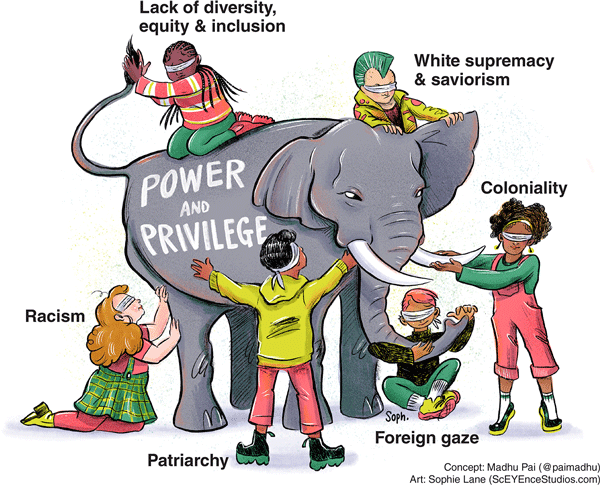
Global health has many asymmetries in power and privilege. Image source: Madhukar Pai, with artwork by Sophie Lane. Reprinted under the terms of the Creative Commons Attribution License.
1.5 Intersectionality
Culture is not merely a matter of race or language, but is at the intersection of heritage, language, beliefs, knowledge, behavior, common experience, and self-identity. A culturally sensitive assessment must consider all the aspects that make up cultural diversity, as well as their complex interactions (Mortaz Hejri et al., 2022).
Intersectionality helps us understand that no one experiences racism, sexism, ageism, or classism separately but by how these practices combine. This matters clinically because health interventions broadly designed around one group can fail to account for how race and class change access, trust, and risk within that group.
Intersectionality matters in healthcare because:
- Algorithms and clinical guidelines built on non-representative data can introduce bias into supposedly neutral tools such as pulse oximeters (reading less accurately on darker skin), or spirometry (using “race correction” formulas).
- Power and privilege affect access to insurance, transportation, paid sick leave, and a regular provider.
- Historical abuses have shaped why some communities distrust institutions today.
- Clinical trials underrepresent women, racial minorities, and disabled people, so privilege literally shapes what counts as evidence.