
Carefully designed activities can have a positive effect on depression, confusion, and challenging behaviors. Activities should provide a positive experience, be meaningful, and be challenging.
Telenius et al., 2022
Whatever the stage of a person’s dementia, everyone wants activities to be meaningful. We like helping one another, teaching someone a new skill, and contributing to the success of an activity. Caregivers often make the mistake of doing everything for the person they are caring for, stripping them of any meaningful way to contribute, to help, to learn, and to grow as a person.
4.1 Individual Activities
My 89-year-old mother Jane often expressed longing for a dog, but she knew she would be unable to walk and care for one. She was adamant that she stay in her own home but eventually it was no longer possible. It turned out her care facility had a golden retriever dog that lived in the unit. Mother was very pleased to see him, and it helped her adjust to living in a care facility.
Jane’s daughter, Kansas City
Successful individual activity programs for people living with dementia are based on a person’s likes, dislikes, and interests. This means learning about a person’s history and understanding their capabilities and preferences.
Determine whether they can still read, write, or use a computer and what they are physically capable of doing. Individual activities that stimulate the senses—including cooking, singing, exercise, going for a drive, gardening, and aromatherapy—are encouraged at all stages of dementia.

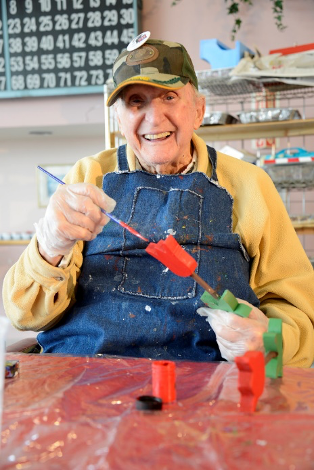
Left: A man using an upper extremity bike to exercise. Source: CDC, public domain. Right: A man enjoying a familiar activity. Southeastern Veterans Center licensed under CC BY-NC-ND 2.0.
Some organizations that serve older adults, such as the Eden Alternative, encourage pets in their facilities. Pets provide companionship, promote relationships, and provide meaningful activity and exercise. Taking care of an animal gives a sense of purpose and companionship and is a key component of person-centered care. Celebrating the holidays is both an individual and group activity, which is interesting and stimulating.
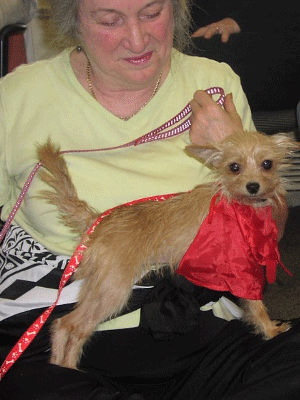

Left: Pet therapy at a skilled nursing facility. Source: CDC. Right: A woman celebrating Halloween. Source: Author.
Some people may refuse to participate in activities. Be on the lookout for signs of frustration and agitation and address these behaviors immediately.
Individual Activities at Different Stages of Dementia |
|||
|---|---|---|---|
Activity |
Mild |
Moderate |
Severe |
Word games |
Word searches and crossword puzzles. Card/computer games. |
Simple word searches and simple crossword puzzles. Simple computer games. |
Discuss a simple topic. Listen to others. |
Letter writing |
Write a letter. Send email; use Facebook, social media. |
Dictate a letter or email. Use Facebook with help. |
Listen to a letter or email being read. |
Art/Music |
Take photos. Create a photo album. Draw, play an instrument. |
Take photos. Maintain a photo album. Draw, sing along with others. |
View photos Listen to music. Sing along to familiar songs. |
Woodworking |
Use tools. Plan and complete projects with assistance. |
Use simple tools with supervision. Assist with projects |
Use activity board with bolts, screws. Watch projects. |
Sewing |
Use sewing machine with help. Plan and complete projects with help. |
Use simple tools with supervision. Assist with projects. |
Use sewing cards, activity blankets or aprons with buttons, snaps, ties, Velcro, and zippers, watch projects |
Gardening |
Garden in raised beds. Help plan the garden and harvest. |
Perform specific tasks with supervision. Eat food grown in garden. |
Sit in garden, eat food grown in garden. Participate as able. |
Crafts |
Knitting or crochet using large needles. |
Choose colors, roll balls of yarn. |
Choose colors, use the items that are created. |
At home activities |
Help with laundry, put clothes away, assist with housekeeping. |
Sort and fold laundry. |
Fold laundry—may want to fold the same items repeatedly |
Shopping |
Go along to store, help with purchasing decisions. Help put groceries away. |
Go along to store, help as able with shopping decisions. Help put food away |
Go along to store, sit in car with supervision or shop with wheelchair or electric cart |
Pet Therapy |
Go for a walk with the pet. Help groom or feed the pet. |
Go along with a person taking the pet for a walk. Help groom the pet. |
Hold the pet. Watch the pet play. |
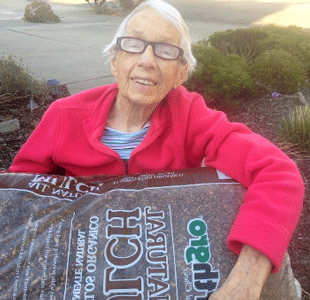
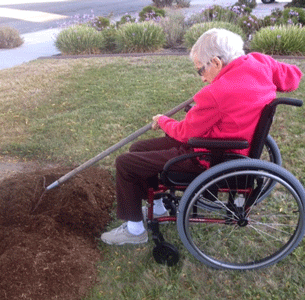
The author’s mother helping with gardening—an activity she had done her entire life. Source: Author.
4.2 Group Activities
Cognitive impairment isolates us from other people, causing anxiety, depression, withdrawal, and decreased self-confidence. Meaningful group activities help all of us maintain a sense of self-worth.
Small groups of 5 to 6 people allow more personal attention, although well-planned large-group activities can also be successful. Keep in mind that, as a person’s dementia progresses, group activities can become more challenging and individual activities may be preferred.
Group Activities at different Stages of Dementia |
|||
|---|---|---|---|
Activity |
Mild |
Moderate |
Severe |
Singing |
Sing while reading words. |
Sing familiar songs. |
Listen and sing along. |
Cooking |
Bake cookies; prepare a snack plate for others. Clean up after cooking. |
Participate in making cookies; assist with cleaning up. |
Help decorate cookies that are already baked; eat the cookies. |
Nature |
Nature walks, outings to nature areas, fruit picking. |
Shorter walks. Picnicking outdoors. |
Escorted walk or wheelchair outside the facility; attend picnic |
Crafts |
Make ornaments. Decorate room or facility for holidays. |
Participate in making ornaments. Assist with decorating for the holidays |
Participate in crafts. Participate in decorating parties. |
Outings |
Shopping, eat out. Theater and music events, museum visits, library visits, attend sporting events. |
Same as mild with some adaptation and more supervision. |
Set up a store where the resident can purchase items. Watch movies; outings with direct supervision. |
Group exercise programs such as walking, resistance training, and seated exercises that focus on improving aerobic endurance, strength, balance, and flexibility are beneficial.
An innovative group exercise program developed at the University of California at San Francisco integrates principles from several well-established traditions including Feldenkrais Method, Rosen Method, Tai Chi, and yoga, with elements from occupational therapy, physical therapy, and dance movement therapy (Chao et al., 2021).
The program, Preventing Loss of Independence through Exercise (PLIÉ), was specifically designed to address the needs of people living with cognitive impairment using seven guiding principles (Chao et al., 2021):
- Repetition with variation (to promote procedural learning while maintaining engagement).
- Progressive, functional movement (to support basic functional movements such as standing safely from a seated position).
- Slow pace and step-by-step instruction (to enable participants to participate fully, experience feelings of success, and minimize cognitive demands).
- Participant-centered goal orientation (a goals assessment is performed at the beginning of the program, and instructors tailor content to address the personal interests and goals of participants).
- Body awareness, mindfulness, and breathing (to bring nonjudgmental awareness to the body in the present moment).
- Social interaction (participants sit in a circle, and many movements involve reaching across the circle to touch hands or elbows or standing in a circle holding hands and moving together to facilitate social connection).
- Positive emotions (participants are encouraged to move in ways that feel good, personally meaningful music is incorporated, and all classes end with sharing of appreciations and things that bring joy).
4.3 Virtual Reality
There has been a great deal of research done in recent years on the use of virtual reality (VR) programs for older adults (with and without dementia). VR programs are designed to reduce loneliness, improve physical activity, and engage older adults in activities such as virtual travel.
Virtual reality offers a multisensory experience that can be attractive for people living with dementia because it stimulates multiple senses. VR may be helpful in improving memory, dual tasking,* and visual attention. For some people living with dementia, it can reduce anxiety, improve feelings of well-being, and increase use of coping strategies (Stasolla et al., 2024).
*Dual tasking: doing two things at once, such as walking and talking or cooking dinner while watching television.
Although the use of virtual reality is often user-friendly and well-accepted by older clients, side effects can occur. The most common reported side effects associated with virtual reality use include cybersickness (nausea, dizziness, disorientation, postural instability, and fatigue). Some people have reported delusions, strong negative emotional responses, upsetting memories. Adverse effects can also include vestibular-related side effects, physical experiences, and psychological impacts (Woo and Lee, 2023).
Some older virtual reality study participants reported issues with the head-mounted device, including that it was too heavy; caused general discomfort, disorientation and imbalance; and caused feelings of being trapped, confined, afraid, or anxious (Healy et al., 2022).
For a person living with Lewy body dementia, cognition can fluctuate from day to day. A person’s response to the use of a virtual reality device can be good one day and cause confusion, hallucinations, and panic the next day. To prevent cognitive overload* and hallucinations—especially in clients with Lewy body dementia—the virtual reality experience needs to be tailored to the user’s own capabilities. Keeping the programs simple and providing close monitoring can reduce or prevent these adverse reactions.
*Cognitive overload: when the brain tries to process too much information all at once.