
I don’t know any baby who ever cried themselves to death, but I do know of too many cases where parents got frustrated by the baby crying and we ended up in a quite terrible situation. We always want parents to have a support system. If you are the primary caregiver and you’ve reached your end, it’s always appropriate to say to a partner, grandparent, a support person, or somebody you trust, “Can you take over because I’ve had enough of the crying baby?” And it’s also perfectly fine to take a crying baby and put them in a nice safe sleep environment like a crib and walk away and calm yourself down, do something that relaxes and rejuvenates you, so you don’t get frustrated with this crying baby.
Cindy Christian, MD, NICHD, 2013
After a thorough examination to rule out a dangerous health condition, interventions generally consist of offering parental or caregiver support, with an emphasis on reassuring parents that exhaustion and frustration are normal. Various soothing techniques, especially decreased stimulation for the baby, may be effective. Walking the baby or going for a drive, gentle massage, turning the lights down, feeding in a darkened room, avoiding perfumes, and keeping the baby away from siblings and pets may decrease crying and help the infant and everyone else get to sleep (Rosenthal and Hein, 2023).
Parents should also be encouraged to develop their own emotional coping responses for fussiness, to minimize the likelihood that they will become frustrated and injure their infant. Parents or caregivers upset by a bout of nonstop crying should place the baby safely in a crib and walk away to avoid shaking the infant and causing harm. If possible, they should take breaks, take turns, or ask for help from trusted family or friends (Banks, et al., 2023).
The National Center on Shaken Baby Syndrome refers to the weeks of most intense crying as the period of PURPLE crying. Many hospitals and birthing centers provide new parents with information about this phase to encourage them to view it as normal and to seek coping strategies.
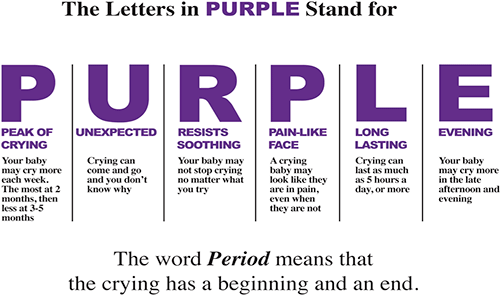
The Period of PURPLE crying. Source: National Center on Shaken Baby Syndrome.
https://dontshake.org/purple-crying
As seen above, each of the letters in PURPLE stand for a property of crying in healthy infants that can frustrate parents and caregivers:
P = peak pattern, in which crying increases at about 2 weeks, peaks in the second to third month, and then declines
U = unexpected bouts of prolonged crying that come and go
R = resistance to soothing
P = pain-like look on the child’s face when they are crying
L = long crying bouts—up to 35 or 40 minutes per bout
E = bouts of crying tend to occur in the late afternoon and evening although they can happen at any time of the day
The PURPLE program also emphasizes three main points:
- Parents are encouraged to use typical calming responses (carry, comfort, walk, talk) with their infants.
- If the crying is too frustrating, it is okay put the baby down in a safe place, walk away, calm yourself, and then return to check on the baby.
- Never shake a baby.