
The “small things” are particularly important in ensuring that care is genuinely supportive of the individual and enhances that person’s autonomy and well-being. The humanity with which assistance is offered, especially help with eating and intimate care, is crucial in helping the person retain their self-esteem and dignity.
Nuffield Council on Bioethics
Activities of daily living are the personal tasks we do during our daily lives. ADLs are divided into two categories: basic ADLs and instrumental ADLs. Basic ADLs are those skills needed to take care of personal needs. Instrumental ADLs are the more complex skills needed to function within society and within the community.
Older adults living in an assisted living facility may need less assistance with ADLs than people in other longterm care settings. Nevertheless, nearly two-thirds of ALF residents require assistance with 3 or more activities of daily living (Pillemer et al., 2024).
Basic and Instrumental ADLs | |
|---|---|
Basic ADLs (skills needed to take care of personal needs)
| Eating, bathing, showering, grooming Walking Dressing and undressing Transfers, toileting |
Instrumental ADLs (skills needed to function within the community and society)
| Housework Financial management Shopping, preparing meals Communicating with the outside world Medical management |
3.1 General ADL Strategies
When assisting anyone with their activities of daily living, encourage them to express their wishes. If someone refuses your help, try to understand why. Are they scared? Do they misunderstand what you asked them to do? Are they embarrassed? Are they cold or in pain?
If the person seems confused, repeat your request, using the same words or slightly rephrasing the question. Rephrasing the request can support understanding and reduce frustration. Offer simple choices, such as “Would you like to shower now or after you eat?” Be calm and empathetic. Examples of empathetic responses include “You must be cold” or “Are you uncomfortable in that chair?” “What would help now?”
Best practices include:
- Make eye contact (where culturally appropriate).
- Be aware of your body language and vocal tone.
- Slow the speed of your movements and speech.
- Approach from the front.
3.2 ADL Strategies: Mild Dementia
A person living with mild dementia may need very little help, if any, with basic activities of daily living. They can get dressed, bathe, do chores around the house and in the yard, and may still be able to shop and cook. They will likely begin to need help with complex tasks such as balancing a checkbook or paying bills.
At this stage, there may be some loss of interest in hobbies and activities. Mood changes, such as depression and anxiety, can occur. Learning new tasks, especially complex tasks, may be difficult. Faulty judgment and mild changes in personality may become obvious to family members and caregivers.
In the early stage, mood changes, such as depression and anxiety can affect ADLs. Learning new tasks, especially complex tasks, may be difficult. Faulty judgment and mild changes in personality may become obvious to family members and caregivers.
Dressing
- Encourage choice in the selection of clothes.
- Allow the resident to direct the activity.
Grooming
- Encourage independent grooming, provide tools if needed.
- Monitor progress and provide help as needed.
Eating
When dementia is mild, a caregiver may only need to supervise during meals and snacks. If there are no underlying medical issues, a person living with mild dementia may still be able to help with shopping, cooking, and dishwashing. In the mild stage, a person may still be able to prepare their own meals. Caregivers can supervise and provide help at a distance. Mild memory problems can lead to safety issues, such as forgetting to turn off the stove or leaving water running.
Placing food on a colored plate (for food contrast) and altering the meal schedule to suit the needs of the person living with dementia are recommended practices.
- Ask for food preferences.
- Ask for help with meal preparation and meal set-up.
- Provide adaptive utensils if needed.
- Provide help as needed.
- Provide comfortable seating and support for the feet.
- Make sure food is tasty, warm, and attractive.
Bathing
A person living with mild dementia may not need help with bathing. At this stage, the responsibility of the caregiver is to assist as needed and encourage independence. This is best accomplished by making sure the bathing area is safe, warm, and comfortable. Grab bars and non-skid mats should be available. Bathing supplies should be within reach and the water pre-heated to the proper temperature.
Although it’s important to be flexible, try to set a regular time for bathing. Be gentle with fragile skin (avoid scrubbing). Practice these techniques (Alzheimer’s Association, 2026a):
- Simplify the bathing process.
- Cue the person through each step, if needed.
- Use a bench or shower chair for comfort and safety.
- Assist with cleansing hard-to-reach areas, if needed.
- Offer a sponge bath in between baths or as an alternative to bathing.
- Give choice as to when, where, and what type of bathing.
- Assist in the decision to bathe.
- Assist with bathing or shower as needed.
- Monitor for safety and comfort.
Toileting and Incontinence*
A person living with mild dementia may be reluctant to ask for help. They will likely be able to get to the bathroom without assistance but might have trouble managing their clothing. The Alzheimer’s Society has partnered with The Able Label, an English company that offers stylish clothing for men and women designed to make dressing and “assisted dressing” easier. Clothing that is easier to manage along with assistive devices such as grab bars and safety poles improve safety and support independence.
A person living with mild dementia may try to address incontinence by cutting back on liquids to decrease the frequency of urination. This can lead to constipation and urinary tract infections, creating a difficult and vicious cycle of dehydration, infection, and incontinence. If balance is an issue, encourage men to sit to urinate rather than stand.
- Monitor and assist as needed.
- Encourage fluids even though more bathroom visits may be necessary.
*Be aware that some medications cause constipation while others increase or decrease the urge to urinate.
3.3 ADL Strategies: Moderate Dementia
There is often a clear delineation between mild and moderate dementia. While progression varies, middle stage dementia is characterized by measurable executive dysfunction, impaired sequencing, and an increased need for direct supervision and support for safety, planning, and task initiation.
In the moderate stage, caregiver responsibilities increase. Cooking, housework, and shopping require more direct assistance. Basic ADLs may require assistance for set-up and safety and may be disrupted by behaviors such as anger, frustration, and denial.
Dressing
- Provide comfortable clothes with elastic waistbands and Velcro closures.
- Encourage participation in the choice of clothing but limit choices.
- Assist closely but encourage independence.
- Lay out clothes in order.
- Provide more than one choice of favorite outfits.
- Provide adaptive equipment such as grab bars as needed.
- Provide step-by-step cues.
- Demonstrate the task.
- Provide guided touch as support to initiate the task.
Grooming
For mouth care and other grooming tasks, provide a safe and comfortable place for these tasks, assist as needed, and offer clear instructions. For men, especially in the moderate to severe stage of dementia, an electric razor provides a safe way to shave. For both men and women, regular visits to the beauty parlor or barber shop provides social interaction and reduces caregiver burden.
- Limit choices (“Would you like lipstick today?” “Would you like to brush your hair?”).
- Encourage as much independence as possible.
- Provide an electric razor for safety and independence.
- Help with the application of makeup and skincare products if needed.
- Assist men with the trimming and cleansing of facial hair.
- Keep nails clean and trimmed (use a file if preferred by client).
- Assist with brushing teeth, use an electric toothbrush if needed.
- Use floss holders, oral irrigators, or interdental brushes if the client has difficulty with mouth care.
- Be aware of dry mouth, provide artificial saliva if needed.
- Visit the dentist on a regular basis.
Eating
As a person’s dementia progresses to the moderate stage, the need for caregiver assistance increases. Swallowing difficulties may arise in the moderate stage, increasing the risk of aspiration* and choking. Preparing softer foods, cutting food into smaller pieces, and avoiding food that is hard to chew or swallow can help address this issue.
*Aspiration: inhaling food of liquid into the lungs.
If signs of dysphagia (swallowing difficulties) are present, a speech‑language pathology evaluation needs to be ordered. Any recommendations for softer food textures and thickened liquids should be guided by a speech‑language pathologist, as these modifications are based on clinical assessment rather than general practice.
- Ask for food preferences.
- Set up the meal before serving.
- Open packages and uncover trays.
- Provide adaptive tableware as needed (see picture at the end of this section).
- Sit to the side while helping (sitting in front may be intimidating).
- Make sure the person has swallowed before introducing more food (food can be pocketed in the cheeks).
- Provide high-calorie, healthy foods to eat or drink (protein drinks, dietary supplements, or foods prepared with healthy fats).
- Consider a multivitamin (tablet, capsule, powder, liquid, or injection).
- Fully set up the meal before serving.
- Monitor closely and be ready to provide feeding assistance.
- Offer liquids on a regular schedule.
- Allow plenty of time to finish eating.
- Be aware of the potential for aspiration of food or fluids.
Bathing
In the moderate stage, additional safety equipment will likely be needed. This might include a shower chair, replacement of a shower door with a curtain, and a long shower hose. Depending upon a person’s physical capabilities, tub bathing may no longer be safe.
Although it’s important to be flexible, try to set a regular time for bathing. Be gentle with fragile skin (avoid scrubbing). Practice these techniques (Alzheimer’s Association, 2026a):
- Simplify the bathing process.
- Cue the person through each step, if needed.
- Use a bench or shower chair for comfort and safety.
- Assist with cleansing hard-to-reach areas, if needed.
- Offer a sponge bath in between baths or as an alternative to bathing.
- Provide set-up assistance.
- Provide guided touch to support or help initiate a task.
- Ask about bathing preferences.
- Initiate and monitor the activity.
- Provide direct assistance as needed, particularly for showering.
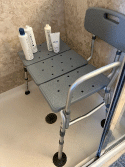
- Provide adaptive equipment such as shower chairs and grab bars as needed (see picture at the end of this section).
Toileting and Incontinence
A person living with moderate dementia may have decreased mobility, have difficulty getting to the bathroom, and may be unable to undo clothing once in the bathroom. Men may experience problems directing their penis—especially if balance is compromised and there is nothing to hold onto. If this is the case, encourage men to sit on the toilet to urinate. Grab bars or transfer poles allow more independence with toileting.
- Provide close assistance, particularly with transfers.
- Label bathroom door for easy identification.
- Provide toileting on a regular schedule.
- Provide adaptive equipment such as grab bars, transfer poles, and toilet chairs as needed.
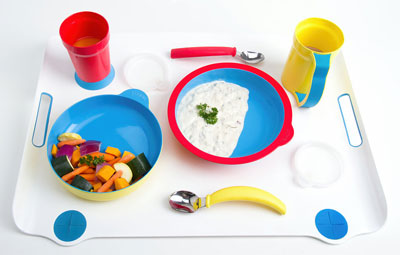
Left: An example of a complete set of assistive tableware. This tableware design used research from Boston University. According to the study, colors help a person living with dementia by reducing visual impairment. People using this type of tableware consume 24% more food and 84% more liquid. Designed by Sha Yao, Eatwell.com. Used with permission.
Right: A shower chair with rail and back. Source: Author.
3.4 ADL Strategies: Severe Dementia
My mom has pretty severe dementia and needs lots of help with everything. I start getting her ready at least an hour-and-a-half ahead of appointments. When she’s dressed and bathed and I think we’re ready to go, she insists on brushing her teeth. Because we were already late, I tried to get her to go without brushing her teeth. Big mistake! She grabbed the door leading from the kitchen to the living room, sat down on the floor, and refused to move. She actually leaned back and put both of her feet and hands on the door opening and wedged herself in. After she brushed her teeth and was safely in the car, she yelled at me to hurry up because she said we were going to be late!
Family Caregiver, Cottondale, Florida
In the severe stage, a great deal of independence is lost, and around-the-clock supervision is often needed. Caregivers must oversee and directly assist with eating, bathing, walking, dressing, and other daily living activities. Difficulty swallowing (dysphagia) can develop in the later stage of dementia, leading to aspiration.
To prevent this from happening, food choices need to be modified by softening the texture of food and adding a thickening agent to liquids. Tucking the chin, massaging the throat, rotating the head, sitting in a supported, upright position, and taking smaller bites of food when swallowing can also help. These practices should only be implemented under the guidance of a licensed speech-language pathologist. Avoid the use of sedatives and narcotics, which can affect swallowing.
A person with severe dementia may still be able to walk with assistance. But anything that requires planning, sequencing, or judgment is severely impaired. Close assistance will be needed for dressing, meal preparation, and grooming. Control of bodily functions can be inconsistent, requiring direct help with bathing and toileting. If mobility is compromised, close assistance will be needed for all ADLs.
For caregivers, healthcare providers, direct care workers, and family members, this is the stage of dementia that requires all of your patience, skill, and expertise. People still want to participate in social activities, use the bathroom without assistance, get out of bed whenever they want, and live in the way they have lived for their entire lives. These needs, desires, and habits are deeply embedded in our psyche, and it requires a great deal of skill on the part of caregivers to understand these changes and provide support in a dignified and respectful manner.
In the severe stage, individuals typically require extensive assistance with ADLs, even total care. Executive function is profoundly affected, mobility is often significantly limited, and bowel and bladder function is commonly lost.
Dressing
- Limit choices, select clothes and set them out.
- Choose comfortable clothing that is easy to wash.
- Use simple, one-step commands and gestures.
- Encourage as much independence as possible.
- Provide assistive equipment such as transfer bars and grab bars.
- Provide as much assistance as needed but encourage independence.
Grooming
- Provide as much assistance as needed.
- Move slowly, limit choices.
- Use one-step commands and gestures.
- Provide an electric razor for safety, help if needed.
- Assist as needed with the application of makeup and skincare products.
- Assist men with the trimming and cleansing of facial hair.
- Keep nails clean and trimmed.
- Assist with brushing teeth by providing step-by-step instructions.
- Use an electric toothbrush if needed.
- Use floss holders and oral irrigators if needed.
- Be aware of dry mouth, provide artificial saliva if needed.
- Visit the dentist on a regular basis.
Eating
In the severe stage, managing oral nutrition supplements, modifying food, and considering dysphagia (swallowing difficulties) can become a daily concern for caregivers. Proper ergonomic seating and simple swallowing techniques can be taught at this stage by a speech-language pathologist to reduce the risk of aspiration (food accidentally going into the lungs). Nevertheless, caregivers should continue to encourage independence and choice in food and drink.
Assistance, encouragement, and social support encourage eating and drinking. A person living with severe dementia may still be able to help with some parts of meal preparation—even if they only beat an egg, peel an orange, or pour juice into a cup. Remember that spilled food can always be cleaned up.
Behavioral issues can arise at this stage—refusals to eat and drink, complaints about food taste and quality, throwing food, shouting, knocking over glasses, and refusal to come to the table. Many of these things can be avoided—especially in the home setting—by adjusting to, listening to, and addressing a person’s changing needs.
Assistive or adaptive tableware can be used to make meals more pleasant. Attractive assistive tableware can be used by people of all abilities, and at all stages of dementia. Color contrast helps as a visual cue—for example royal blue plates provide a contrast with a white table covering and food on a plate. A plate with a high lip and slanted bottom helps a person push the food onto the spoon and scoop it up.


The slanted bottom and lip of the plate can help users to gather food on one side without scooping. Spoon heads are designed to match the curvature of the bowls to pick up the food more easily. (Designed by Sha Yao, Eatwell.com. Used with permission. From http://www.eatwellset.com/#!features/cf1a.)
The same approach can be used with cups. In the example below, a royal blue bottom and a white cover help a person with low vision or agnosia* locate the cup handle and rim. The sides of the cup are angled to reduce spillage, a large handle assures a good grip, and a wide top allows a person’s nose to fit inside the cup when tipped.
*Agnosia: a sensory disorder in which a person is unable to recognize an object by sight, touch, or hearing.


A cup with a weighted bottom is shown on the left. A cup with an easy-to-grip handle is shown on the right. Designed by Sha Yao, Eatwell.com. Used with permission.
Because dementia is a progressive disease, a person will gradually lose the desire to eat. This can be extremely distressing for caregivers even though it is a normal part of the disease progress. Caregivers who have worked hard to keep a person eating and drinking may struggle as it becomes harder and harder to convince the person they are caring for to eat and drink. This will be accompanied by weight loss—sometimes severe.
- Ask for food preferences and provide small amounts of food at a time.
- Let the person know what they are eating.
- Sit to the side while helping (sitting in front may be intimidating).
- Offer a bite of the meal and a bite of something sweet.
- Make sure the person has swallowed before introducing more food (food can be pocketed in the cheeks).
- Provide high-calorie, healthy foods to eat or drink (protein drinks, dietary supplements, or foods prepared with healthy fats).
- Consider a multivitamin (tablet, capsule, powder, liquid, or injection).
- Fully set up the meal before serving.
- Provide adaptive equipment as needed.
- Monitor closely and be ready to provide feeding assistance.
- Offer liquids on a regular schedule.
- Allow plenty of time to finish eating.
- Be aware of the potential for aspiration of food or fluids.
Bathing
In the severe stage, direct help is likely needed with bathing. Shower chairs, grab bars, transfer poles, and even modifications allowing a rolling shower chair may be needed. Caregivers should expect to get wet at this stage as they assist with bathing. Continue to encourage as much independence as is safe and possible.
General considerations for bathing*:
- Provide complete bathing care.
- Retain as much of a person’s earlier bathing rituals as is reasonable.
- Use the person’s behavior as a guide.
- Provide assistive equipment such as shower chairs, transfer poles, and grab bars.
- Ask about bathing preferences.
- Initiate and monitor the activity.
- Provide direct assistance as needed, particularly for showering.
- Provide adaptive equipment such as shower chairs and grab bars as needed.
- Consider bathing habits (time of day, bath or shower).
- Consider bed bath if more acceptable to client.
- Provide guided touch to support or to help initiate a task.
*Consider bathing habits (time of day, bath or shower); consider bed bath if more acceptable to resident.
There are times when a person may need to be bathed in bed. This is not uncommon at, or near, the end of life. Bed bathing is not as effective as showering and should only be used when there is no alternative. Cleanliness promotes skin health and supports dignity. Even at this stage, caregivers should encourage participation and consider a person’s preferences for bathing.
General principles for bed bathing:
- Keep the person warm.
- Expose only the area being washed.
- Change water when dirty and after washing genital areas.
- Pat skin dry rather than rubbing.
- Talk to the person (even someone who is unconscious).
Toileting and Incontinence*
As dementia becomes more severe—and physical, sensory, and cognitive skills continue to decline—toileting becomes more difficult. A person living with severe dementia may do some things that are extremely frustrating to a caregiver. They may hide soiled underwear, hand feces to the caregiver, or wipe feces off their hands onto clothing or furniture. A person may resist help, fail to remove clothes before voiding, or void in inappropriate places.
A person living with severe dementia may or may not be able to walk without assistance but, due to sensory changes and decreased vision, may have difficulty locating or recognizing the bathroom. This probably won’t stop them from trying, increasing the risk of falls. Caregivers can find this stage extremely frustrating and stressful—partly because more physical help and direct oversight are needed, and partly because more time is spent cleaning up accidents.
- Expect both bowel and bladder incontinence requiring total care.
- Set up timed toileting schedule.
- Provide assistive equipment such as transfer bars and grab bars.
- Check for skin breakdown, skin rash and redness, and infections and treat promptly.
- Review medications that may contribute to incontinence.
- Restrict drinks that contain caffeine.
- Change adult diapers regularly and keep the area clean and dry.
*Goal is for client to be clean and comfortable. Shower or tub bath is not necessary—a sponge bath may suffice.
Urgency, urinary frequency, lower abdominal pain or tenderness, blood in the urine, pain or burning sensation with urination, and changed mental status can be signs of a urinary tract infection, which should trigger a urinalysis and urine culture. Catheter-associated urinary tract infections are common and can occur when germs enter the urinary tract by way of the catheter. Caregivers should consistently clean their hands before touching a catheter.
People in the last stage of dementia have the highest need for assistance from staff and caregivers and are often completely dependent on help. At the same time, they need a quiet environment. These clients tend to become overwhelmed by sensory impressions and can have a hard time interacting with other people due to intellectual and emotional impairment (Lygum et al., 2025).
For caregivers, healthcare providers, direct care workers, and family members, this is the stage of dementia that requires all of your patience, skills, and expertise. People still want to use the bathroom without assistance, get out of bed whenever they want, and live in the way they have lived for their entire lives. These needs, desires, and habits are deeply embedded in our psyche, and it requires a great deal of patience and wisdom on the part of caregivers to understand these changes and provide support in a dignified and respectful manner.