
A caregiver is someone who assists a person in physical, financial, or emotional need. Caregivers help with basic needs such as bathing, dressing, walking, and cooking, or with more complex tasks such as medication, financial, and home management. Caregivers can provide direct care or manage care from a distance (or a combination of both) and can be a family member, a neighbor, a friend, a paid caregiver, or a healthcare professional.
Caring for a person living with dementia is a huge commitment and places emotional, financial, and physical strain on family caregivers. As a person’s dementia progresses, caregiving can become a fulltime, unpaid job. Good care can break down quickly if caregivers fail to get enough sleep, do not take care of their own medical needs, or do not access support and training.
More than 80% of the assistance for older adults in the U.S. is provided by informal caregivers, who generally are family members, relatives, and friends providing unpaid care for family members with chronic diseases such as dementia (Shubair, 2025).
Caregivers of people living with dementia provide care for a longer time, on average, than caregivers of older adults with other conditions. They are more likely than caregivers of people without dementia to provide help with self-care and mobility and health or medical care. Yet half of caregivers of people living with dementia indicate they have no experience performing these tasks (Alz.org, 2025).
For professional caregivers, managing the stress associated with caring for a person living with dementia can be emotionally exhausting. Aggression (experienced or observed), repeated questions, agitation, high care needs, deaths, and the affects of illness and disease are events that activate stress in professional caregivers. Unpleasant interactions and poor treatment from residents, their families, co-workers, and supervisors are also factors that cause professional caregivers’ stress (Antipas et al., 2025).
Professional caregivers have individual risk factors that may predispose them to experiencing occupational stress. For example, caregivers who speak English as a second language (when working in English-speaking facilities), have a higher level of job-related education, identify as male, and are of a younger age may experience more occupational stress. Caregivers with less than one year of experience or with limited social relationships outside of work may also be at higher risk of experiencing occupational stress (Antipas et al., 2025).
For professional caregivers, training in assessment and non-pharmacological strategies to reduce challenging behaviors in people living with dementia has a positive effect on a professional caregiver’s self-efficacy, sense of personal accomplishment, and can positively influence a professional caregiver’s feelings of stress (Antipas et al., 2025).
5.1 Types and Causes of Stress for the Caregiver
When my mom still had a good appetite, could walk around the house, take care of her garden, answer the phone, and manage the TV, it was easy. As her dementia progressed, lack of sleep, family squabbles, and having to directly help with everything made things much more stressful. There were more medical appointments with a very disinterested and unhelpful doctor. I ignored my own needs (I didn’t get a haircut for over a year!) because there was no one to watch her while I was gone.
Family Caregiver, West Palm Beach, FL
5.1.1 Emotional Stress
Providing care for a person living with dementia can be overwhelming and stressful. There is loss of free time, isolation, feelings of stigma and, in some cases, feelings of a lack of gratitude by the person receiving the care.
More than half of people caring for a person living with dementia rate the emotional stress of caregiving as high or very high and about 40% report symptoms of depression. One in five cut back on their own healthcare visits because of their care responsibilities (Alzheimer’s Association, 2025).
A caregiver’s emotional state is influenced by the severity of dementia, the perceived effectiveness of treatment, safety issues, challenging behaviors, and social support. Caring for a person living with dementia can lead to health problems such as hypertension and sleep disorders (Li et al., 2024).
Caregivers can experience high levels of anxiety, depression, stress, and distress, which can harm the quality of the relationship between the caregiver and person they are caring for, sometimes leading to caregiver negligence. A caregiver’s emotional stress can get worse as a person’s dementia progresses, especially when a caregiver does not understand the reason behind a challenging behavior (Li et al., 2024).
More than half of people caring for a person living with dementia rate the emotional stress of caregiving as high or very high and about 40% report symptoms of depression. One in five cut back on their own healthcare visits because of their care responsibilities (Alzheimer’s Association, 2025).
5.1.2 Financial Stress
For family caregivers, the economic impact of caregiving is a stressor. A study examining caregivers for older adults found that a 1% increase in caregiving hours corresponded to an approximately 10% decrease in the employment rate among caregivers.
Alzheimer’s Disease International
Each year more than 12 million family members and friends provide over 192 billion hours of unpaid care to those with Alzheimer's and other dementias, a contribution valued at nearly $413 billion (Alzheimer’s Association, 2025).
The financial strain on caregivers is a well-known challenge and the vast majority experience financial difficulties. Caring for a person living with dementia is estimated to cost nearly $400,000 per person over the course of the disease, 70% of which is borne by families in the form of unpaid care and out-of-pocket expenses (Shubair, 2025).
Caregivers of older adults living with dementia report lower household incomes compared to caregivers of individuals without dementia. Limited financial resources reduce access to paid support services and increase reliance on family care, increasing the strain on caregivers. Financial stress has also been associated with adverse psychological and physical health outcomes among caregivers, further compounding the already heightened demands of dementia care (Shubair, 2025).
For families, there are many hidden costs associated with dementia-related care, including (Carlozzi et al., 2025):
- Costs to caregiver physical and mental health.
- Lost income (for both the family members and the person living with dementia).
- Impulsive spending or poor spending decisions (by the person living with dementia).
- Depletion of savings.
In addition, families contemplating supportive care placements for the person living with dementia (assisted living or nursing home care) must consider the economic impact on the family household. The lost income of the person living with dementia, as well as asset depletion from costs associated with assisted living, can be financially devastating, especially for lower-income families (Carlozzi et al., 2025).
For professional caregivers, understanding the strain placed on families and family caregivers is crucial. This is due to the longer clinical course of dementia, substantial informal care costs, and disease-specific financial challenges that dementia caregivers must contend with (Carlozzi et al., 2025).
5.1.3 Physical Stress
Physical stress and musculoskeletal injuries are common among family caregivers, home health aides, nurses, nursing assistants, home care providers, and physical and occupational therapists. Care settings can be unpredictable and cluttered, and many facilities lack proper assistive equipment and help.
Assisting a person with transfers, positioning, bed mobility, bathing, toileting, and other daily activities is physically demanding. Handling equipment, lifting a person after a fall, and providing support during transfers can lead to physical strain and injury. A caregiver’s physical stress is related to their age, physical fitness, the amount of assistance they provide, and the amount of time spent providing care.
For a person living with dementia, maintaining as much independence as possible reduces the physical stress on caregivers. Light weight wheelchairs, transfer poles, lift chairs, grab bars, overhead bars in the bed, and other assistive equipment improve independence and reduce a caregiver’s physical strain.
Factors and Characteristics Associated with Caregiver Stress | |
|---|---|
Factors |
Characteristics associated with caregiver stress |
Demography |
Female caregiver Spousal caregivers, particularly those of younger people living with dementia Living with the care recipient, low incomes, or financial strain |
Caregiver personality |
Highly emotional or neurotic caregivers |
Perception and experience of caregiving role |
A lack of confidence by the caregiver in their role Caregivers feeling trapped in their role |
Coping strategies |
Emotion-based or confrontive coping strategies Type and severity of dementia Behavioral issues such as apathy, irritability, anxiety, depression, delusions |
Relationship factors |
Intimacy—poor relationship quality, low levels of past and current intimacy |
5.2 Identifying and Assessing Caregiver Stress
There are dozens of tests and scales that can help identify and assess caregiver stress. Yet caregiver stress is regularly overlooked by healthcare professionals. This may be partly because caregivers minimize their stress, have guilt about feeling stress, and are reluctant to focus attention on their own problems.
Healthcare workers and providers can support caregivers by helping them understand that caregiver needs are as important as the needs of the person they are caring for. During an appointment or visit, a screening tool can assess the amount of stress the caregiver is experiencing.
Caregiver burden can be measured using the short Zarit Burden Interview in Dementia (ZBI) tool. It explores four items related to a caregiver’s self-care, stress, and burden and is scored from 1 (never feel stress) to 5 (almost always feel stress), for a total score ranging from a minimum of 4 points to a maximum of 20 points. Caregiver burden is present when the total score is greater than or equal to 10 and considered to be absent when the score is less than 10 (García-Martín et al., 2023).
Caregiver distress can also be measured using the Neuropsychiatric Inventory Caregiver Distress Scale (NPI-D). This tool asks caregivers to rate their level of caregiver distress using a 0-5 scale:
0 = not at all distressing,
1 = minimally distressing,
2 = mildly distressing,
3 = moderately distressing,
4 = severely distressing, and
5 = very severely or extremely distressing (García-Martín et al., 2023).
5.3 Strategies for Reducing Caregiver Stress
Reducing caregiver stress is possible when education, training, support, and respite are available. These four components can decrease caregiver stress and reduce or delay the transition from home to a care facility (ADI, 2022).
Caregivers can reduce their stress by paying attention to their own health. This means getting enough sleep, eating properly, seeing their own healthcare providers, and sharing their feelings about their caregiving duties with co-workers, family, and friends. Providing caregivers with emotional, social, psychological, and technological support reduces their stress and supports them in their role as caregivers.
Interventions that are effective in supporting family caregivers include (Alz.org, 2025):
- Actively involving family caregivers in the intervention.
- Tailoring the intervention to meet the changing needs of family caregivers during the course of a relative’s dementia.
- Meeting the needs of both caregivers and the person living with dementia.
Addressing Caregiver Stress | |
|---|---|
Reducing Caregiver Stress |
Things to Avoid |
|
|
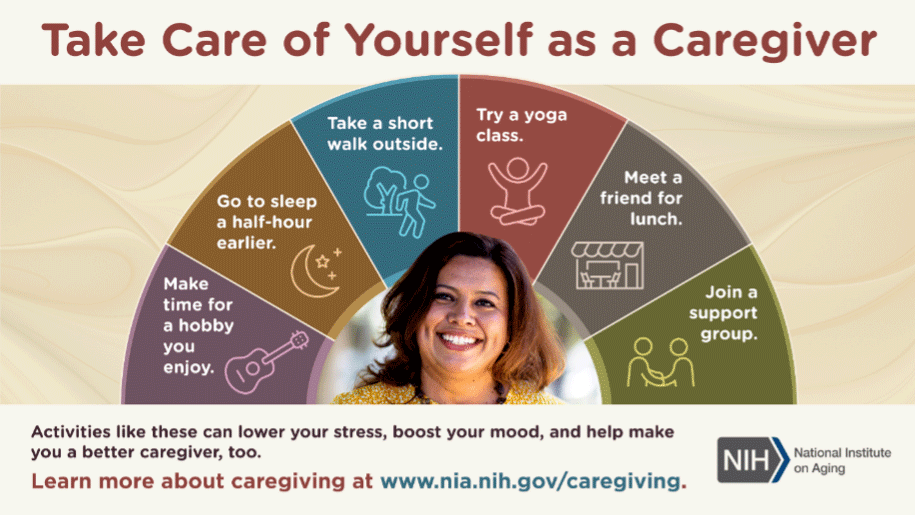
Source: https://www.nia.nih.gov/health/caregiving/take-care-yourself-caregiver
5.3.1 Respite Care
Respite services support caregivers by providing time away, a chance to relax and recharge, and time for errands and other tasks. These services may be available in a person’s home, an adult daycare center, in the community, or in long-term care communities.
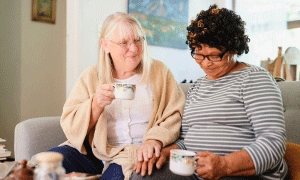
Respite care can provide relief for family caregivers. Source: NIH, public domain.
Respite is one of the most needed and desired services for caregivers and is a good way to maintain and enhance caregiver wellbeing over time. When scheduled regularly and in sufficient doses, respite gives caregivers a temporary break to tend to their own health, maintain social and family relationships, and pursue aspects of their daily lives that they may have neglected as a result of the caregiving demands (Utz et al., 2023).
5.3.2 Positive Aspects of Caregiving
Although it is commonly believed that someone caring for a person living with dementia is under a great deal of stress (especially as the person’s dementia progresses), caregivers also encounter positive experiences. These positive aspects can play an important role in the caregiver’s stress and well-being (Yuan et al., 2023).
Greater satisfaction was associated with more emotional support from family members and friends (Alzheimer’s Association, 2025).There can also be an increase in family cohesion and functionality with a sense of personal growth and purpose in life (Wiegelmann et al., 2021).
Although caregivers report positive feelings about caregiving, such as family togetherness and the satisfaction of helping others, they also frequently report higher levels of burden and stress; depression or other adverse mental health outcomes; strain; and problems with navigating care transitions when compared with other caregivers or non-caregivers (Alz.org, 2025).
5.3.3 Caregiver Bill of Rights
A caregiver bill of rights was first crafted by Jo Horne in her 1985 book CareGiving: Helping an Aging Loved One. Her widely adopted principles, although not legally binding, have provided a framework for additional research on the critically important role that informal, unpaid caregivers play in the care of dependent older adults.
The original caregiver bill of rights contains nine items that encourage caregivers to consider their own health and well-being and to set boundaries. Among other things, the Caregiver Bill of Rights states, “I have the right to”:
- Take care of myself.
- Seek help from others.
- Maintain facets of my life that do not include the person I care for.
- Get angry or depressed.
- Resist attempts by the person I am caring for to manipulate me.
- Receive consideration, affection, forgiveness, and acceptance from the person I am caring for.
- Take pride in what I am doing.
- Protect my individuality.
- Demand resources to support and aid caregivers.