
Human trafficking is present in every country despite worldwide efforts to stop it. More than 180 nations adhere to the UN TIP Protocol to Prevent, Suppress, and Punish Trafficking in Persons,* which defines trafficking in persons (TIP) and contains obligations to prevent and combat these crimes.
Human traffickers recruit, harbor, transport, provide, or obtain a person through force, fraud, or coercion—for the purpose of exploitation, compelled labor, services, or commercial sex. It is a crime that affects all ages, races, genders, and cultures. Human trafficking is about profit.
The Trafficking Victims Protection Act of 2000 and the UN TIP Protocol focus on the trafficker’s (USDOS, 2025, January 20):
- Acts
- Means
- Purpose
An act is when a trafficker recruits, harbors, transports, provides, or obtains another person for labor, service, or commercial sex. An act is sex trafficking when the trafficker patronizes or solicits another person for commercial sex.
Means is when a trafficker uses of force, fraud, or coercion to compel the other person to engage in labor, services, or commercial sex. Purpose is when the perpetrator’s goal is to exploit a person for labor, services, or a commercial sex act.
Key Principles and Concepts (USDOS, 2025, January 20)
- Consent: Human trafficking can occur even if the victim initially consented to providing labor, services, or commercial sex acts.
- Movement: Neither U.S. law nor international law requires that a trafficker or victim move across a border for a human trafficking offense to take place.
- Debt bondage: Crimes in which the trafficker’s primary means of coercion is debt manipulation. U.S. law prohibits perpetrators from using debts as part of their scheme, plan, or pattern to compel a person to work or engage in commercial sex.
- The non-punishment principle: A victim-centered and trauma-informed approach is key to successful anti-trafficking efforts.
- State-sponsored human trafficking: Some governments directly compel their citizens into sexual slavery or forced labor schemes.
- Unlawful recruitment or use of child soldiers: Occurs when government forces or any non-state armed group unlawfully recruit or use children—through force, fraud, or coercion—as soldiers or for labor or services in conflict situations, including as sex slaves.
- Accountability in the private economy: Forced labor is a well-documented practice in the private economy, particularly in agriculture, fishing, manufacturing, construction, and domestic work, but no sector is immune.
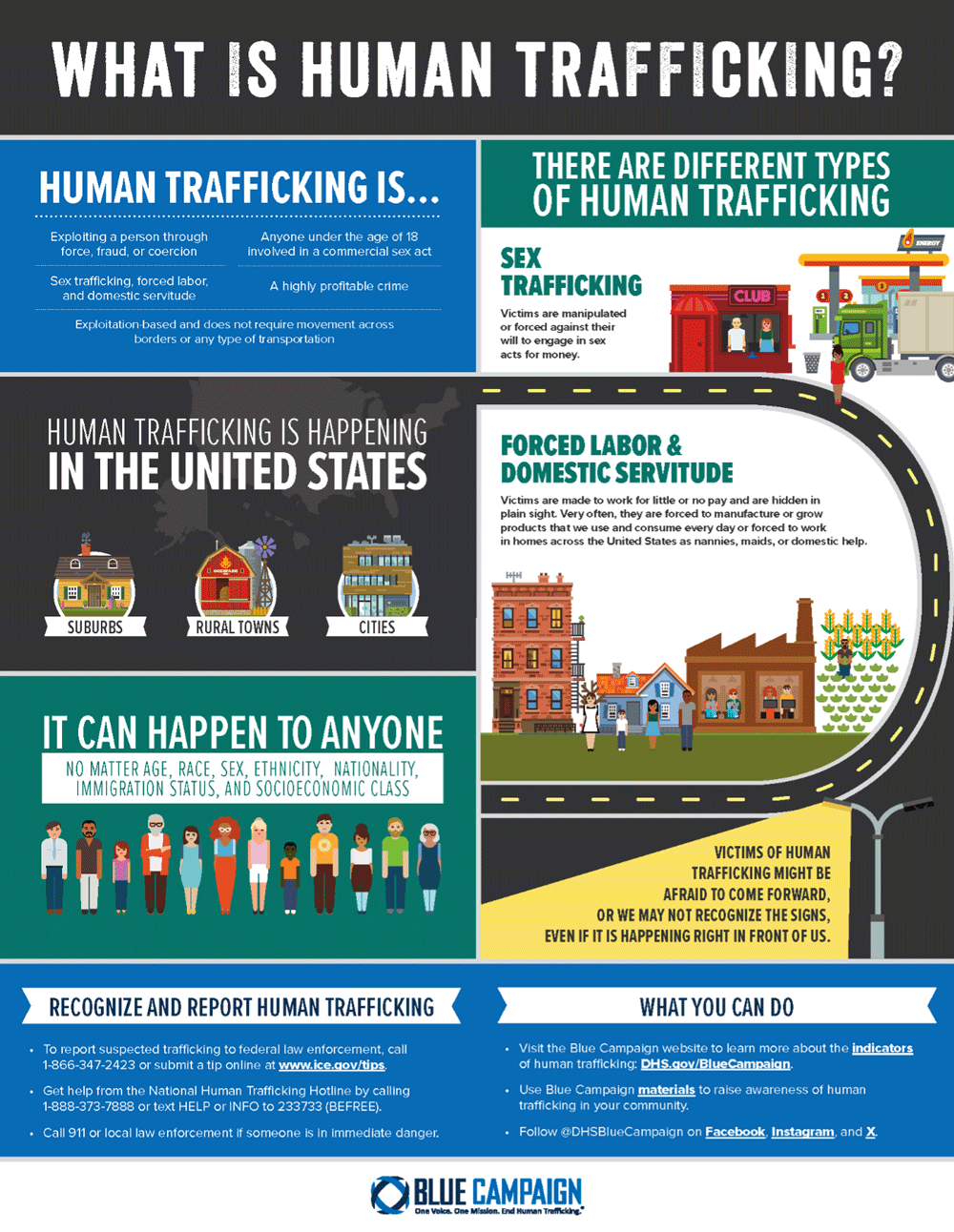
Description of human trafficking, how it can happen to anyone, and how it is happening in the United States; that there are different types; how to recognize and report. Source: DHS Blue Campaign. Public domain.
Human trafficking virtually never begins with kidnapping or other violent acts. Traffickers almost always know their victims. They are friends, acquaintances who offer jobs, members of their own families, or romantic partners (Polaris Project, n.d.).
1.1 Labor and Sex Trafficking (22 U.S.C. §7102)
The Trafficking Victims Protection Act of 2000 created the modern criminal statutes under which human traffickers are investigated and prosecuted. The Act defines “severe forms of trafficking in persons” by separating the two distinct forms:
- sex trafficking
- labor trafficking
1.1.1 Sex Trafficking
Sex trafficking is the recruitment, harboring, transportation, provision, obtaining, patronizing, or soliciting of a person for the purpose of a commercial sex act*, in which:
- The commercial sex act is forced, faked, or compelled by force, fraud, or coercion or
- the person induced to perform the commercial sex act has not reached 18 years of age, regardless of whether force, fraud, or coercion was involved.
It is illegal to receive a benefit from sex trafficking or engage with a person who is trafficked for sex.
*Commercial sex act: any sex act in exchange for which something of value is given to or received by any person.
1.1.2 Labor Trafficking
Labor trafficking is the recruitment, harboring, transportation, provision, or obtaining of a person for labor or services, using force, fraud, or coercion for the purpose of subjection to involuntary servitude, peonage, debt bondage, or slavery (DHS, 2025, May 22). Types of labor trafficking include forced criminality, involuntary servitude, peonage, debt bondage, and slavery.
Construction workers who have worked in natural disaster recovery and reconstruction are significantly more likely to experience labor trafficking and other forms of labor abuse than those who have not worked in this setting. The prevalence of labor trafficking among workers in construction post-disaster was two times higher than those who did not (32% compared to 16%) (Barrick & Pfeffer, 2024).
Specific types of exploitation that were significantly higher among individuals who worked in construction post-disaster include experiences with coercive and deceptive recruitment, having pay or benefits withheld or deducted, completing hazardous work without proper protective gear, emotional or psychological abuse, and threats of violence, among others (Barrick & Pfeffer, 2024).
Did You Know. . .
[One] study of labor trafficking and other labor abuse in the construction industry indicated that these practices are common. About one-fifth of these workers reported they had experienced labor trafficking victimization (Barrick and Pfeffer, 2024).
1.2 Force, Fraud, or Coercion in Human Trafficking
The concepts of force, fraud, and coercion are the core means by which human trafficking is accomplished, as defined in federal law (22 U.S.C. § 7102). They are the tools traffickers use to compel a person into commercial sex acts or involuntary labor.
1.2.1 Force
Force means the use of a weapon, physical strength, or violence to overcome, restrain, or injure a person. It also includes inflicting physical harm to coerce or compel submission. Force is the threat of physical assault or sexual violence to the victim and others around them, including family members. Force can include:
- assaulting the victim physically or sexually
- confining or isolating the victim
- withholding food, sleep, or medical care
- seizing of identity documents
1.2.2 Fraud
Fraud is the use of a deceitful or willful practice, with intent to deprive another person of their rights, or to injure them in some manner. Fraud is used to trick a victim using deception and misrepresentation. Fraud often involves false promises of jobs or other opportunities.
Examples of fraud include:
- False promises: education, good-paid jobs, debt relief, money to support a person’s family, or the promise of a better life.
- Deceptive relationships: false promises of a romantic relationship (grooming) or a parent/mentor relationship.
- Wage theft: misrepresenting or withholding wages or manipulating debt (debt bondage) to make the victim financially dependent and perpetually indebted to the trafficker.
1.2.3 Coercion
Coercion is the use of manipulation or threats designed to control a person psychologically and physically. Common coercive tactics include taking identity documents, threatening arrest or deportation, inhumane treatment, blackmail, shaming, isolation, and addiction. Economic coercion occurs when a trafficker takes advantage of existing debt or creates a debt (DHS, 2025, May 22).
Coercion is defined in federal law as:
- threats of serious harm to or physical restraint against any person
- any scheme, plan, or pattern intended to cause a person to believe that failure to perform an act would result in serious harm to or physical restraint against any person
- the abuse or threatened abuse of the legal process
1.3 Human Trafficking vs. Human Smuggling
While both human trafficking and human smuggling involve the movement of people, they are fundamentally distinct crimes under the law, defined by consent and intent. The terms are not interchangeable.
A victim of human trafficking is forced into service against their will, whether through direct physical force, deception, fraud, psychological manipulation, or coercion. The lack of free will and restriction of movement are crucial elements of trafficking. Trafficking does not require the crossing of state or international borders. The trafficker profits from ongoing exploitation of the victim.
A person can be trafficked in their own home or in your own country. Consent does not mean human trafficking has not occurred; a minor under 17 years of age cannot legally consent to sex. Victims of human trafficking usually do not reach out for help, often due to fear of retaliation, authority, or deportation or due to shame or guilt.
Human smuggling is the facilitation, transportation, attempted transportation, or illegal entry of a person or persons across an international border, in violation of a country’s laws, either clandestinely or through deception. This often includes the use of fraudulent documents.
The person being smuggled consents to the arrangement, pays the smuggler, and seeks the service voluntarily, and is usually free to go when they reach their destination. The smuggler's profit comes from the one-time fee charged for the transportation service. The focus is on the logistics of moving the person. A victim of smuggling can also be a victim of trafficking.
1.4 Sex Trafficking vs. Consensual Commercial Sex
The crucial difference between sex trafficking and consensual commercial sex lies in force, fraud, or coercion, and the individual's age. Sex trafficking is a crime of exploitation—it is non-consensual (forced)—while consensual commercial sex is a negotiated transaction. The core crime of trafficking involves using force, fraud, or coercion to maintain control and prevent the victim from leaving.
Sex trafficking always involves a third party (the trafficker/pimp) who profits from the victim's sexual services. Sex trafficking is a federal felony, which entitles the victim to legal protection and other services.
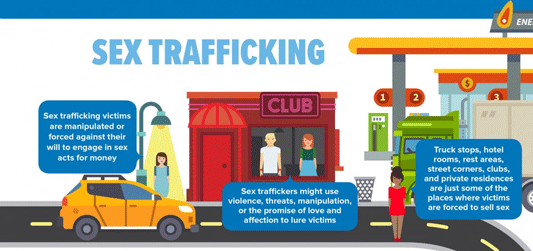
Source: Department of Homeland Security.
Commercial sex is a consensual exchange of sexual services for money or goods, initiated by an adult over the age of 18. The core act is a voluntary agreement to exchange sex for value. Many individuals engaged in commercial sex are driven by vulnerabilities such as poverty, homelessness, addiction, or a history of abuse. This can severely limit their choices and make them highly vulnerable to being coerced by a trafficker.
A person who initially chooses to engage in consensual commercial sex can be subsequently trapped by a pimp or controller using force, fraud, or coercion, making them a victim of sex trafficking. Their initial consent is rendered meaningless if they are unable to leave.
1.5 Anyone Can Be a Victim of Trafficking
Victims of human trafficking can be any age, race, or culture. They are found in any country. Adults and children are exploited in both legal and illegal industries, including in commercial sex, hospitality, restaurants, and traveling sales crews. People working in agriculture, mining, seafood, manufacturing, janitorial services, and construction can be victims.
Healthcare workers, childcare providers, people caring for persons with disabilities, and people doing domestic work or offering salon services can be targets of human trafficking. Workers at fairs and carnivals, those peddling or begging, and those smuggling or distributing drugs are often victims of human trafficking.
Globally, 67% of forced labor victims are men or boys while 33% are women and girls. Within sex trafficking, 78% are women and girls, 22% are men and boys, and 8% are children (DHS, 2025, May 22). Children account for about a quarter of all human trafficking victims globally.
Trafficking occurs in wealthy, middle-class, and poor communities; however, extreme poverty is a significant risk factor because traffickers prey on the need for money, food, and shelter. Victims include both U.S. citizens and foreign nationals (documented or undocumented). Foreign nationals can be vulnerable due to language barriers, fear of deportation, and not knowing their legal rights.
Other groups at risk for human trafficking include:
- runaway, foster, and homeless youth
- victims with a history of trauma or abuse
- people with a history of drug or alcohol abuse
- people involved with gangs
- people with disabilities
- friends or relatives involved in prostitution
1.6 Trafficker Profiles
There is no single profile of a human trafficker except that they are driven by profit at the expense of others. A trafficker is someone who through force, fraud or coercion provides a victim to a buyer. Traffickers often use recruiters to find potential victims.
Buyers often believe they are engaging in a victimless crime, think they won’t get caught, have a sex addiction, or that they cannot get their sexual needs met in an appropriate way. Many admit that seeking to buy sex, especially with a minor, started with an addiction to pornography (Unbound Now, 2022).
Traffickers are men and women of all ages. They are often someone the victim knows. They can be relatives, romantic partners, or close family friends. Or they can be the people behind an employment ad or a new friend on social media or from online gaming (DHS, 2025, May 22).
Traffickers use coercion and threats of violence, deportation, or harm to the victim's family to maintain control and prevent victims from leaving or seeking help. They may charge exorbitant fees for travel, housing, or necessities, ensuring the victim is always in debt and feels compelled to work to repay it. They go to great lengths to keep victims isolated.
Did You Know. . .
Traffickers are often pathological liars and experts at using psychological tactics to create dependency and a sense of loyalty. They are precise and methodical in cultivating and grooming victims. They often lack empathy for their potential victims and are unable to feel or understand the feelings of others, which allows them to view victims as commodities.
1.7 Recruitment Techniques
Many traffickers, especially sex traffickers, initially approach victims by pretending to be a love interest, friend, or helpful acquaintance. They may shower the victim with attention and gifts to build trust before revealing their true intentions.
Traffickers use highly individualized tactics, but their goal is always to identify and exploit a specific vulnerability (such as poverty, a desire for love, or a need for a job) to establish control through fraud and coercion. One of the most common ways that traffickers access children is using social media sites.
Traffickers advertise opportunities that sound “too good to be true”—high wages for minimal effort, lucrative jobs overseas, or fully paid education. They may require an upfront “recruitment fee” that immediately puts the victim in debt. Once the victim accepts, the reality involves grueling work, no pay, seizure of identification, and threats of violence if they try to leave.
Traffickers seek out locations and platforms where people are desperate or have limited options. This includes homeless shelters, foster care facilities, low-income communities, and refugee camps. The trafficker offers basic survival needs (food, shelter, safety) in exchange for a “favor” or a condition of living with them, immediately establishing dependence.
Traffickers often use an existing victim to recruit new people. This makes the existing victim complicit and isolates the trafficker from the initial recruitment risk.
Traffickers may introduce, encourage, or force victims to use drugs or alcohol. They use the victim's addiction as a means of control, either by withholding the substance or demanding commercial sex or labor for more supply. This makes the victim financially and physically dependent on the trafficker.
Other means used to retain victims:
- using force or threats (coercion)
- threatening to report a victim to the police
- playing on the victim’s weaknesses (manipulation)
- offering special treatment to form a “trauma bond”
1.7.1 Vulnerabilities to Trafficking
While it is technically true that human trafficking can happen to anyone regardless of age, socio-economic status, gender, or nationality, it does not happen at random. Traffickers systematically look for a leverage point—a gap in resources, safety, or legal status—to manipulate and control their targets.
Victims can be anyone from around the world or right next door: adults and children of any sex or citizenship status. Significant risk factors include economic hardship, recent migration or relocation, substance use, mental health concerns, involvement with the child welfare system and being a runaway or homeless youth. Often, traffickers identify and leverage their victims' vulnerabilities in order to create dependency.
Vulnerability to trafficking is heavily concentrated around specific systemic, social, and economic risk factors:
- Individuals who have experienced childhood abuse or neglect (especially sexual abuse)
- Children and youth involved in the foster care and juvenile justice systems
- People experiencing homelessness or unstable living situation
- LGBTQ individuals
- Migrant workers/undocumented immigrants
- Racial and ethnic minorities
- People with low incomes
- People with a history of substance abuse or caregiver with substance abuse issues
- Communities exposed to intergenerational trauma
- Survivors of violence
1.7.2 Caring Romantic Partner (Grooming)
Often the trafficker is a man (though, can be any gender) who poses as a caring boyfriend, girlfriend, or romantic partner. The trafficker grooms the victim by providing affection, gifts, and emotional support. Once the victim is emotionally attached (trauma bonding), the trafficker begins to exploit the victim, often framing it as a "test of love" or a temporary sacrifice for their shared future. This creates a relationship in which reward and punishment reinforce the dysfunctional bond.
1.7.3 Familial Trafficking
Parents, guardians, extended family members, or older siblings can engage in human trafficking. In some cases, the family member may have also been a victim or may be struggling with poverty or addiction. Familial trafficking exploits the inherent power imbalance and loyalty within a family, forcing a child into sex work or forced labor to support the family or pay off a family debt.
Children who are no longer with their family of origin may be lured into being trafficked through the false promise of being taken care of by their trafficker and gaining a “family.” Youth who run away from their homes are particularly vulnerable to becoming victims of both sex and labor trafficking.
It can be hard to spot a trafficker: they can be classmates, other peers, or family members. Even after trafficked victims have been separated from their trafficker, they may still feel a strong connection to them and not recognize the harm their trafficker caused. It is important, therefore, for foster parents, caregivers, and child welfare staff to learn how to recognize signs of trafficking and how to respond to victims.
1.7.4 Business Owners, Labor Brokers, Small Business Owners
Businesses and farms, factory managers, labor brokers, or even small business owners can engage in human trafficking. They often share the victim's nationality or language to build trust. These individuals recruit workers with fraudulent job offers. They may own legitimate-looking businesses but then subject employees to involuntary servitude, debt bondage, and inhumane conditions.
1.7.5 Online Predators
Online predators operate anonymously, posing as modeling agents, casting directors, wealthy admirers, or job recruiters on social media, dating apps, or online gaming platforms. Technology allows traffickers to reach a large number of potential victims, isolating them from their real-life support networks before meeting in person.
1.8 The Impact of Trafficking on Survivors
It is very common for people who have been trafficked to experience a form of complex trauma that affects nearly every aspect of their physical, psychological, social, and economic well-being. Symptoms often persist long after a survivor has escaped the trafficking situation.
1.8.1 Psychological and Emotional Trauma
Victims are manipulated by their traffickers, making them feel responsible for the abuse. This can create deep feelings of shame that act as a barrier to seeking help and healing. Due to the betrayal, violence, and manipulation from their trafficker, survivors frequently struggle with paranoia and an inability to form healthy, trusting relationships with others.
Sustained psychological abuse, isolation, and control can lead to severe and enduring mental health conditions. Depression and suicidal ideation and profound feelings of despair, worthlessness, and hopelessness are common. These symptoms can significantly increase the risk of self-harm and suicide attempts.
Post-traumatic stress disorder (PTSD) and complex PTSD (CPTSD) are very common in survivors of trafficking, causing flashbacks, nightmares, hyper-vigilance, and severe anxiety. Complex PTSD, resulting from prolonged, repeated trauma, can cause difficulties with emotional regulation, self-perception, and maintaining relationships.
1.8.2 Physical Health Consequences
Dangerous working conditions, injuries, infections, and denial of medical care can cause chronic and sometimes permanent physical injuries and illnesses. A survivor may suffer from broken bones, scars, head injuries, and chronic musculoskeletal pain from physical violence and forced labor. Working in toxic or unsafe environments can lead to respiratory or cardiovascular issues.
Victims of sex trafficking have high rates of sexually transmitted infections, including HIV/AIDS. They also frequently suffer from unwanted pregnancies, forced abortions, pelvic pain, and infertility due to chronic, untreated infections and physical trauma.
Did You Know . . .
In early 2026, Justice Department files revealed that Jeffrey Epstein and his associates kept a list of doctors that treated their victims for depression, anxiety, STDs, prescribed birth control pills, and inoculated them against HPV.
Traffickers often restrict access to food, leading to severe malnourishment, weight loss, and chronic dental problems. Many survivors are forced by their traffickers to use drugs or alcohol to ensure compliance, or they develop an addiction as a form of self-medication to cope with the pain and trauma.
1.8.3 Social and Economic Isolation
Victims of human trafficking also suffer financial consequences from trafficking. They are often left destitute, in debt, and have lost possessions such as cars or homes. If they were mistakenly arrested or deported related to the trafficking, victims can face difficulties in securing a job, housing, or education to name a few (DHS, 2025, May 22).
Trafficking destroys a victim's social structure and potential future earnings. Survivors frequently face stigma and judgment from the community and sometimes even their own families. Victim can find themselves isolated and have difficulty reintegrating into society. Because traffickers often seize personal documents, a survivor then cannot obtain legal employment, housing, or access services once they are no longer victims of trafficking.
For child victims, there can be significant gaps in their education, limiting their long-term economic and career opportunities. This is compounded by a lack of resources, documentation, family support, and the risk of homelessness, which can expose them to re-exploitation.
2026: Michigan Updates Law on Trafficking
The Michigan legislature passed a law that strengthens earlier legislation and spells out specific crimes to ensure that traffickers are met with justice in the State of Michigan. Not only can victims ask for all costs suffered as a consequence of their bondage, such as medical costs, but they can also ask for a restitution order that finally recognizes the value of the years of their life lost due to the crime (MCL §750.462a).
1.8.4 Re-Trafficking
The risk of re-trafficking is a critical yet underexplored issue. Many survivors remain at risk of re-trafficking due to limited economic opportunities, stigmatization, and unresolved psychological trauma (Nkwanzi et al., 2025).
For female trafficking survivors, adverse childhood experiences contribute to an increased likelihood of re-trafficking. Childhood adversity disrupts emotional regulation and decision-making, making individuals more susceptible to coercion and exploitation. Survivors facing economic instability and social marginalization, which are key aspects of re-trafficking vulnerability, may experience heightened anxiety, depression, and PTSD due to chronic stress and uncertainty (Nkwanzi et al., 2025).
Re-trafficking is not uncommon, with one study indicating that 63.4% of survivors have high levels of vulnerability to re-trafficking. Younger women, particularly those aged 18 to 24 years, at higher risk for trafficking. Those who have been formerly trafficked are at increased risk of re-trafficking due to economic dependence, poverty, lack of social support, limited education, and challenges reintegrating into society after their trafficking experience (Nkwanzi et al., 2025).